
Power Training in Bend Oregon at Any Age: Strength, Plyometrics & Speed Explained


Why strength alone isn’t enough and how to safely train power
Many people focus on getting stronger as they age. Strength is important, but there’s another physical quality that is just as critical for long-term health and performance:
Power.
Power is your body’s ability to produce force quickly. It’s what allows you to catch yourself if you trip, jump over a puddle, sprint after a dog, or push hard on the pedals during a bike climb.
Unfortunately, power is the first muscular adaptation to decline as we age. In fact, it tends to decrease earlier and faster than strength.
For women, this decline can become more pronounced during perimenopause, when hormonal changes, particularly reductions in estrogen, accelerate losses in muscle function and neuromuscular performance.
The good news is that power can be trained at any age, and doing so can dramatically improve strength, mobility, and injury resilience.
What Is Power?
In exercise science, power is defined as:
Power = Force × Velocity
This simple equation tells us something important about training. To increase power, we must improve both:
• Force production (strength)
• Velocity (how quickly force is produced)
This is why someone can be strong but not powerful.
For example, a person might be able to lift a heavy weight slowly but struggle to move lighter loads explosively.
To truly develop power, training needs to include both heavy resistance exercises and fast, explosive movements.

Why Power Training Matters as We Age
Power plays a critical role in everyday movement and long-term health. Research shows that power output is closely related to:
Balance and fall prevention
Walking speed and mobility
Ability to climb stairs
Athletic performance
Reaction time
Because power declines faster than strength, maintaining it becomes increasingly important with age.
For women entering perimenopause and menopause, this becomes even more relevant. Hormonal changes can accelerate muscle loss and reduce neuromuscular efficiency.
The right training program can help counteract these changes by maintaining both muscle mass and the ability to generate force quickly.
Step 1: Build Strength (Force Production)
Before focusing on explosive movements, the body needs a solid strength foundation. Strength increases the force component of the power equation.
The most effective way to develop strength is through resistance training performed at relatively high intensities, typically around 80% or more of one-repetition maximum (1RM).
Exercises should emphasize functional movement patterns, including:
Squats
Deadlifts or hip hinges
Lunges
Pushes and presses
Pulls and rows
Loaded carries
These movements build strength in ways that transfer directly to real-world activities and athletic performance.
Step 2: Train Velocity (Explosive Movement)
Once a strength base has been developed, the next step is improving the rate of force development, or how quickly the body can produce force.
Velocity can be improved through three primary exercise types:
Plyometric training
Ballistic training
Sprint training
Each method challenges the neuromuscular system to produce force rapidly and efficiently.
Plyometric Training
Plyometric exercises use the body’s natural elastic properties to generate explosive movement.
Definition
Plyometric exercises “take advantage of the stretch-shortening cycle to increase force production in the shortest amount of time with the help of elastic components and stretch reflex” (Turner et al., 2020).
These movements include three phases:
Eccentric prestretch (muscle lengthening)
Amortization phase (brief transition)
Concentric contraction (explosive shortening)

Examples include:
Box jumps
Depth jumps
Pogo jumps
Bounding drills
These exercises train the body to absorb and redirect force efficiently.

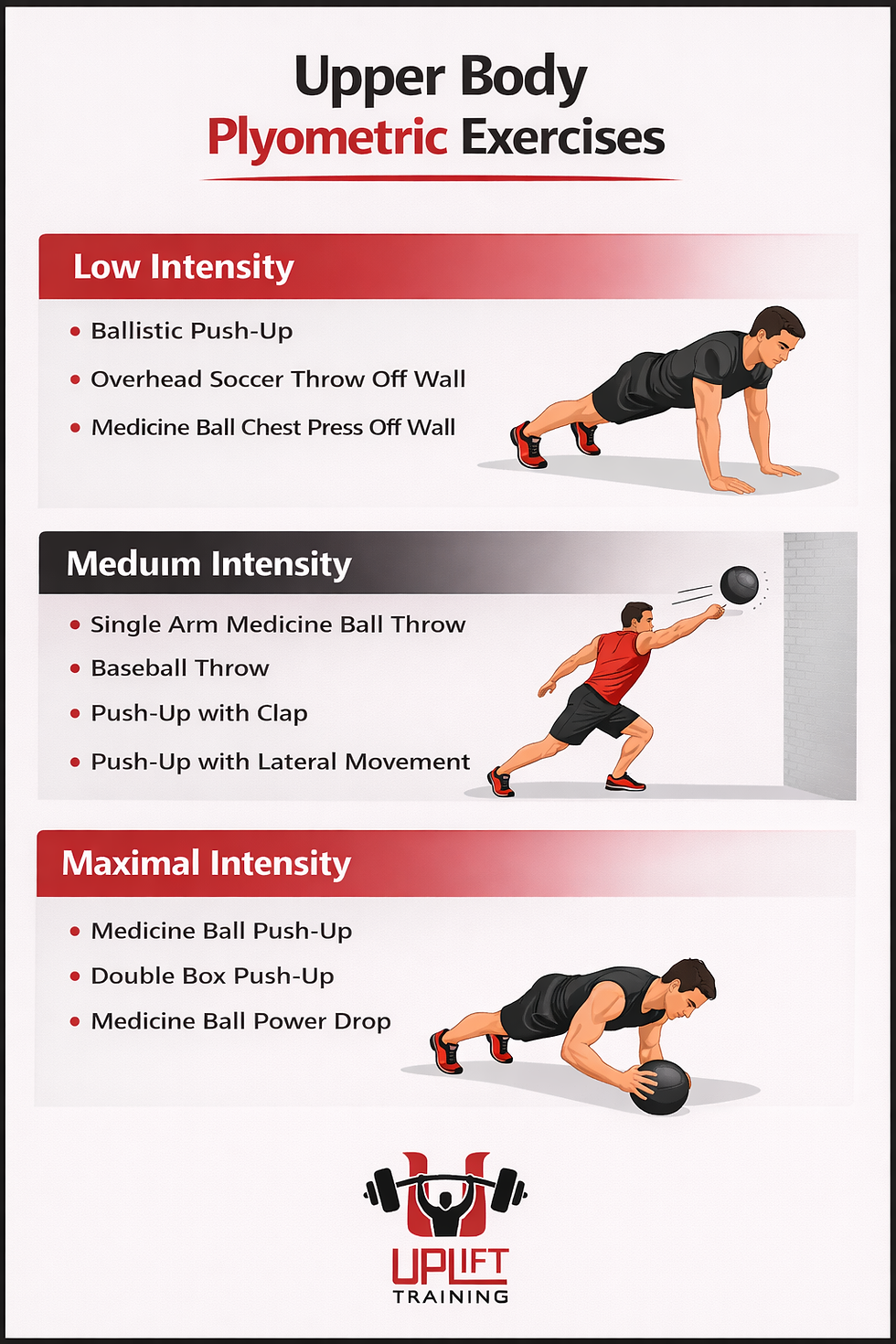
Ballistic Training
Ballistic exercises are explosive movements that involve external resistance.
Definition
Ballistic exercises involve “the explosive release of a body or object.”
They are typically performed with low-to-moderate loads (15–75% of 1RM) at the highest possible velocity.
Examples include:
Weighted jump squats
Kettlebell swings
Olympic lifts
Medicine ball throws
Plyometric and ballistic exercises are often used interchangeably, but for practical purposes it can be helpful to think of them as:
Plyometric = bodyweight explosive movements
Ballistic = explosive movements with load
Choosing the Right Exercise Progression
Power training should always match the athlete’s experience level.
If someone hasn’t jumped in years, starting with advanced plyometrics like depth jumps may not be appropriate. Instead, simpler drills such as hop-and-hold exercises can build coordination, stability, and landing mechanics.
As with all training, technique should always take priority over load or intensity.
Medicine Ball Power Training
Medicine ball exercises are excellent for developing explosive movement because they allow athletes to accelerate through the entire movement.
Examples include:
Chest passes
Overhead throws
Rotational throws
Slams
It’s important to remember that many medicine ball exercises are intended to train both upper- and lower-body power. If the athlete does not load into a countermovement or incorporate a jump before releasing the ball, the movement becomes primarily an upper-body exercise.
Olympic Lifting and Its Derivatives
Olympic weightlifting exercises are well known for their ability to develop power. However, they require substantial technique and mobility. For many athletes, derivatives of Olympic lifts can be just as effective and easier to learn.
Examples include:
Pulls from above the knee
Mid-thigh pulls
Jump shrugs
These movements reduce mobility requirements while still training triple extension, the powerful extension of the hips, knees, and ankles.
Loaded Jump Squats
Jump squats are another effective way to build lower-body power. However, they can produce high landing forces, so athletes should progress gradually and ensure proper strength and technique first.
Some coaches prefer alternatives such as:
Jump shrugs
Hex-bar jumps
These exercises often produce similar power outputs with less landing stress.
Sprint Training for Power
Sprinting is one of the most powerful tools for developing explosive strength. Several sprint training methods have been shown to improve power output:
Repeated maximal sprints: Short all-out efforts improve peak power output.
Sprint interval training: Structured intervals with recovery improve power and metabolic capacity (MacDougall et al., 1998).
Resisted sprinting: Using sleds or other resistance can enhance acceleration power.
Combined strength and speed training: Combining resistance training with plyometrics and sprinting supports neuromuscular and muscular adaptations.
To achieve optimal results, sprint training should adhere to a 1:5 work-to-rest ratio. This implies that if you conduct 10-second sprints, they should be followed by 50 seconds of rest before starting the next 10-second sprint. This approach ensures nearly complete recovery between sprints, enabling each set to be executed at consistently high intensity.
What Works Best for Beginners?
The good news is that many training methods can improve power, especially for new lifters. Research comparing resistance training, Olympic lifting, and plyometric training shows that all three methods can significantly improve strength and power (Cormie et al., 2007; Cormie et al., 2010; Turner et al., 2020).
For beginners, the most important factors are:
Consistent training
Proper progression
Good coaching and technique
In other words, the best program is the one that safely progresses over time.
The Bottom Line for Those Power Training in Bend Oregon
Power training isn’t just for athletes.
It’s essential for maintaining mobility, strength, and independence as we age.
A well-designed training program should include:
✔ Heavy resistance training to build strength
✔ Explosive exercises to improve velocity
✔ Gradual progressions that prioritize technique
With the right program and coaching, people of any age can improve their ability to generate power and move through life with greater strength, confidence, and resilience.
To take your training to the next level and start guided power training in Bend Oregon, click on the button below to schedule your free consultation today.
References
Cormie, P., McBride, J., & McCaulley, G. (2007). Power versus strength-power jump squat training: Influence on the load-power relationship. Medicine & Science in Sports & Exercise, 39(6), 996–1003.
Cormie, P., McGuigan, M., & Newton, R. (2010). Adaptations in athletic performance after ballistic power versus strength training. Medicine & Science in Sports & Exercise, 42(8), 1582–1588.
MacDougall, J. D., Hicks, A. L., MacDonald, J. R., McKelvie, R. S., Green, H. J., & Smith, K. M. (1998). Muscle performance and enzymatic adaptations to sprint interval training. Journal of Applied Physiology, 84(6), 2138–2142.
Turner, A. N., Comfort, P., McMahon, J., Bishop, C., Chavda, S., Read, P., Mundy, P., & Lake, J. (2020). Developing powerful athletes part 2: Practical applications. Strength & Conditioning Journal, 43(1), 23–31.


Comments