
RAMP It Up to Protect Against Injury in the Gym

Updated: Oct 16, 2025

We all know that we should be doing warm-ups prior to training, but we don't always include everything necessary to prepare our bodies for the stress we're about to place on them. A proper warm-up not only increases body temperature, but it activates the muscles that will be used, moves them through a full range of motion, and gradually builds in intensity to prepare for the strength training portion of the session. A proper workout benefits us in several ways. It:
Increases muscle temperature and elasticity
Improves joint lubrication
Improves range of motion
Enhances blood flow to improve nutrient and oxygen delivery to working muscle
Prepares the nervous system for better efficiency and coordination of movement
There are several different ways to construct a warm-up, but one that keeps coming up in recent literature is the RAMP warm-up developed by Dr. Ian Jeffreys. This warm-up, though often thought of as a warm-up for athletes, can be modified for anyone. The key is to work backwards - look at what you plan to do during a training session and plan your warm-up accordingly while keeping in mind any special needs or circumstances, such as injuries and medical conditions.
RAMP stands for (Parker, 2021):
R = Raise
A = Activate
M = Mobilize
P = Potentiate
The RAMP Protocol is composed of three phases.
Raise: In this phase, we increase muscle and core temperature, blood flow, muscle elasticity, and neural activation. This can be done with 5-10 minutes cardiovascular activities such as walking, jogging, biking, rowing, etc. I would also add that if you are an individual that suffers from a respiratory disorder, starting with breathing exercises to warm-up respiratory muscles would be beneficial.
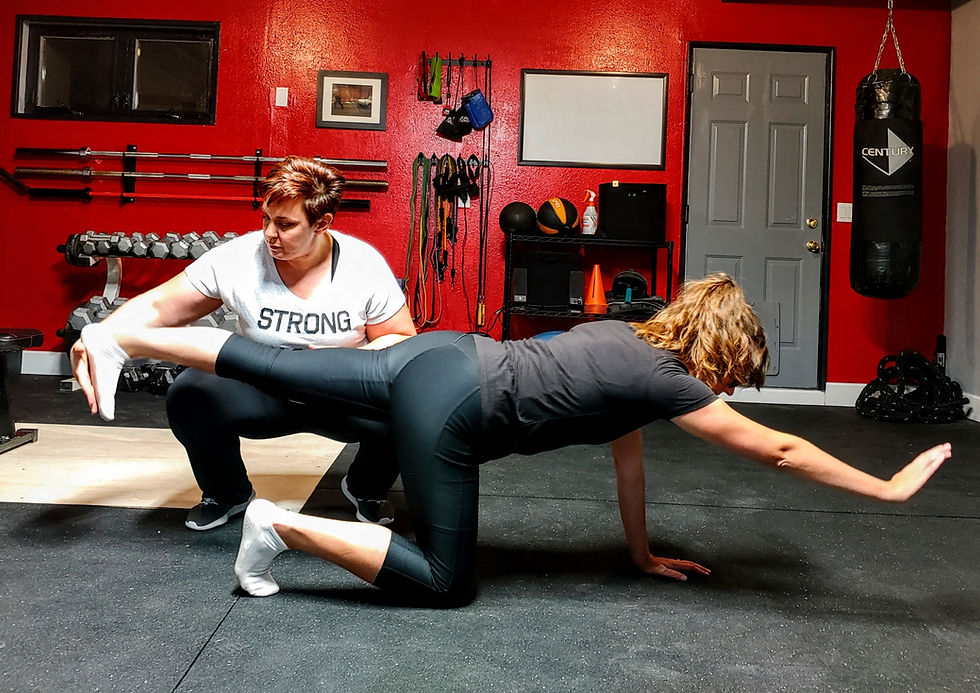
Activate and Mobilize: During this phase, we activate skeletal muscles of the body for the workout and get the body moving by focusing on movement patterns. Appropriate exercises would include dynamic stretches performed through a full range of motion that mimic movements to be performed during the training session. Examples of exercises that can be included are lunges, glute bridges, core stabilizing exercises, etc. It is during this phase that I also like to include exercises that activate weaker or inhibited muscles. For example, if the muscles of the upper back are weaker, I will include exercises like a face pull or external rotation.
Potentiate: This final phase is to gradually increase stress on the body. There are several ways you can program this phase. Just remember, purpose matters. If the warm-up is for a soccer player before practice, this is a great place for agility drills. Going into a heavy strength training day? Start with lighter sets of the exercises you are planning to perform and build to your heavier sets. If your session is programmed to increase power, you can perform strength exercises (i.e. squat) that mimic the power exercise (i.e. clean) you are planning to perform. (Combining a strength exercise with an explosive exercise is called post-activation potentiation and is phenomenal for increasing explosive power.)
Total warm-up time varies depending on population and activity, but generally lasts 10-20 minutes. Remember, a proper warm-up readies the body for activity, reducing the risk of injury. Better yet? It allows us to perform better in our training in both the short- and long-term. Sounds like a win-win to me!
Reference:
Parker, R. (2021, December 1). What is the ramp warm up?. Human Kinetics Blog. https://humankinetics.me/2019/03/04/what-is-the-ramp-warm-up/


Comments